Saturday, April 26, 2025

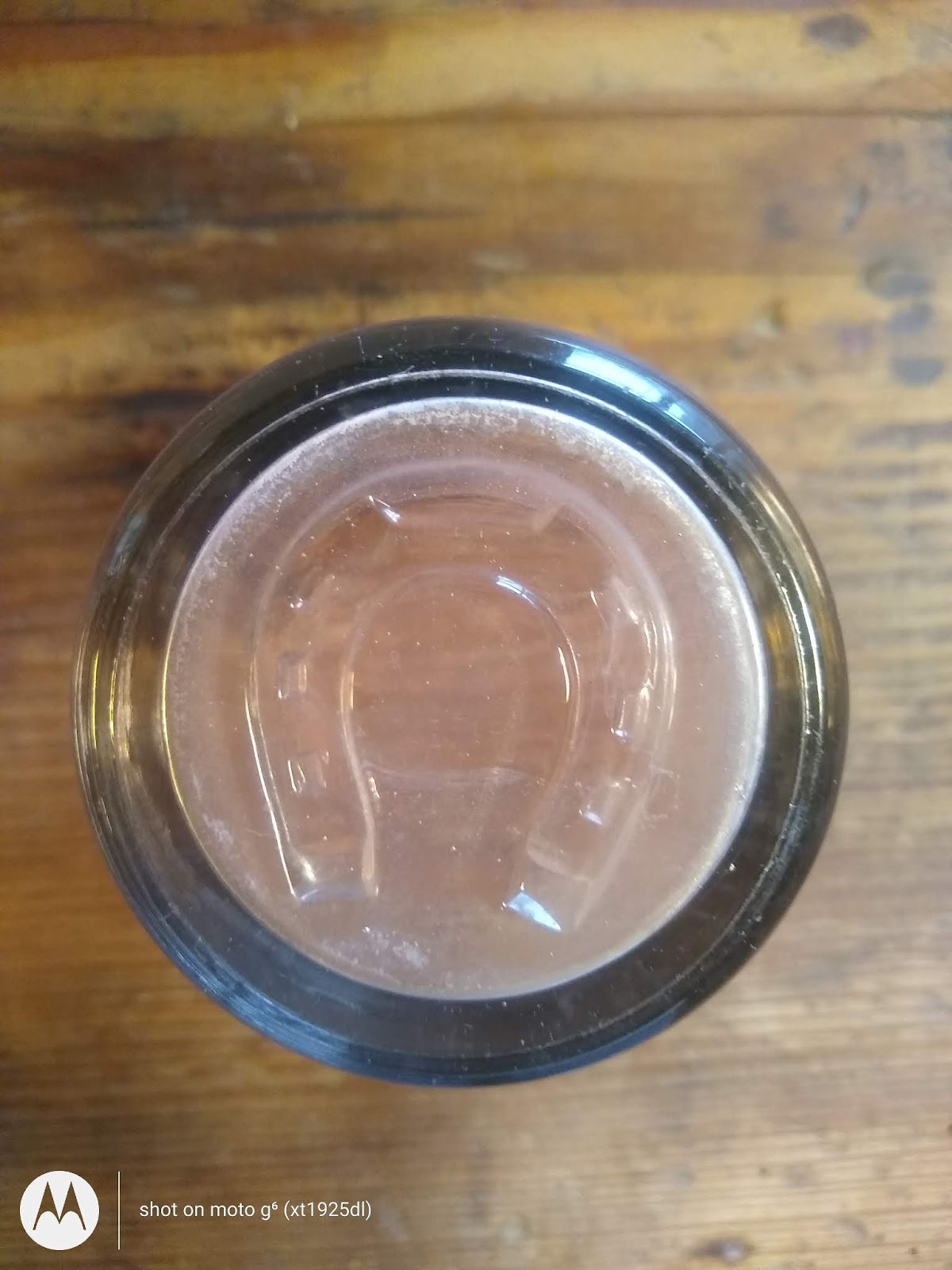
Horseshoe Bottom Glasses

In early Amana many private wine cellars were a favorite socializing spot as they still are today. Often wine was shared in a special pressed glass with a horseshoe and star motif on the bottom. Sometimes there were letters or numbers pressed at the bottom of the horseshoe and the star was not always present.
The glasses were originally made for jam, cheese or peanut butter containers. When the product was used up, the glasses were reused for wine and juice. Some old glasses as these were actually found in old dumps of the early to mid 1900's. Now they are found at Amana auctions, estate sales and local antique shops if used in Amana.
The majority of these glasses were probably made from c. 1900-1930.
Glass manufacturers of these horseshoe marked glasses were located in Indiana, Ohio, and West Virginia. Most well known of the makers were Ball Brothers of Muncie, Indiana; Fostoria of Fostoria, Ohio; and Hazel-Atlas of Wheeling, PA.


Broomstick Christmas Tree

For a special homemade Christmas tree in early Amana, evergreen boughs (long or short needle) were collected and punched into a wooden pole or broomstick laden with drilled holes to hold the fresh greens that were anchored to a stand. Green boughs were gathered from nearby cemetaries or evergreen stands in the woods.The gifts were placed on a tabletop decorated with cookies, candy, small toys, and surrounded by a small picket fence. No gifts were wrapped but all were original and imaginative, arranged carefully, left  open, all on the white linen tablecloth under the tree. A nativity set was also under the special tree. The Christmas Angel was placed at the very top of the tree and about two dozen candles filled the branches and lit the tree. The two holidays ( Feiertage) celebrated for Christmas were filled with joy, treasures, and prayer, a tradition adopted from 18th century Germany. It's predecessor was the wooden pyramid Christmas decoration which originated in the Ore Mountains of Germany. Net photos...


M.Trumpold photo

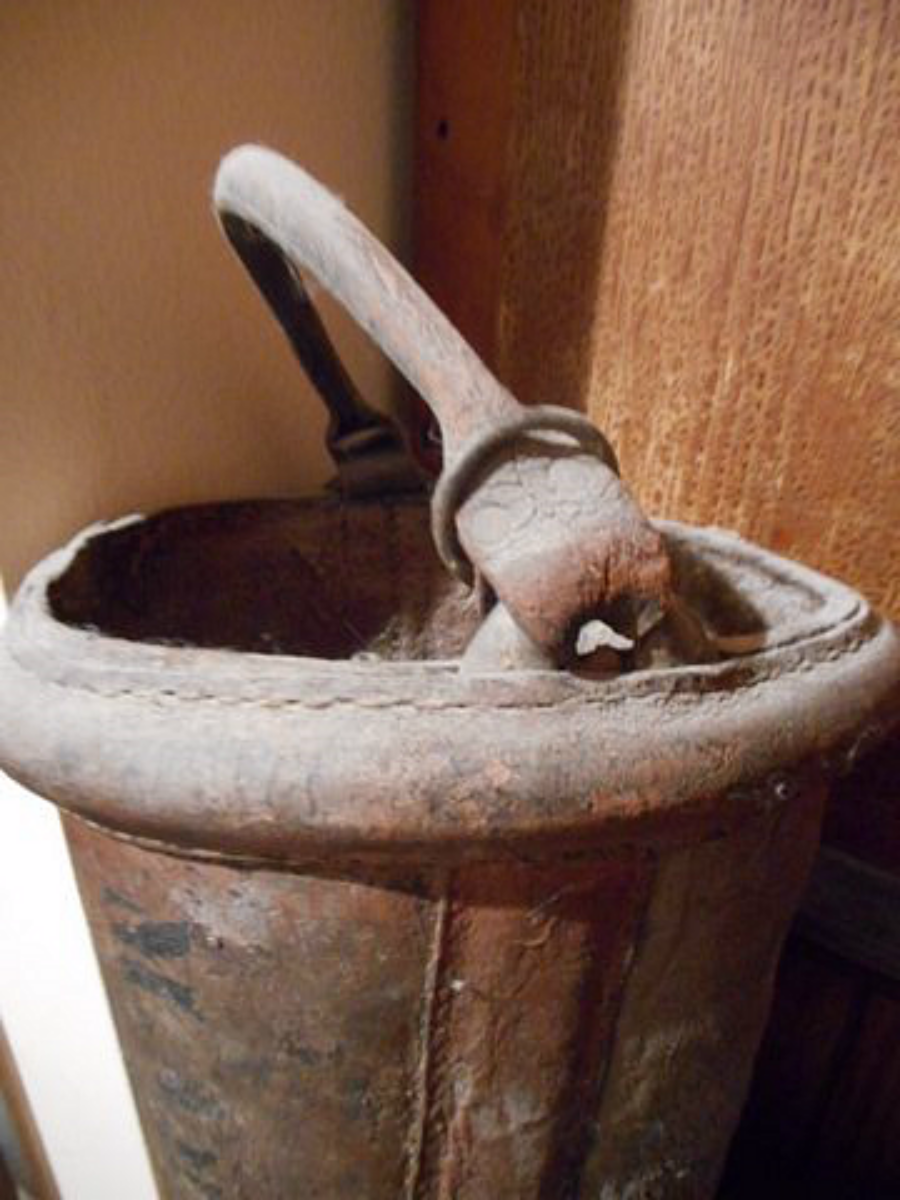
The Fire Bucket


1848 Enenezer NY bucket


Each village of the Amana Colonies had its water works and fire engine. Every strong man was a member of the fire department. The water supply came from deep artesian wells, the one in Amana being 600 feet deep.  The one in Homestead was 2100 feet deep, supplying water for all the village needs. Men would form  long lines, fill the fire buckets with that water and pass them down the lines to put a fire out. Buckets were made of tough leather, tightly stitched by the harness makers or shoe makers and printed with black letters to identify its station. The bucket handle was rolled and sewn, very strong. There was a bucket by each stove so it was readily available in case of fire. Early buckets in American history were made of gourds or leather. This is a very necessary, well made object now seen as a rare art form. They have quite a heritage, age, and design...The Amana Heritage Museum owns the black one.
Photos by Renate and a KS clients friend


R.Hess photo


Beer, Wine and Medicine Bottles


 The pharmacies in the Amanas supplied the doctors with tinctures, medicines, salves, and much more for cures or to sooth any ailments in the community. Many different sizes of bottles have been found. Many are embossed in clear, brown or blue glass. Handwritten in old script with black ink are special features of the labels on bottles. Several were old typed labels. Very unique bottles.

Stifel Calico

In my collection of indigo CALICO prints, I have found several pieces with a boot stamped on the back of the fabric. These pieces are from the Stifel Calico Works of Wheeling, West Virginia. The mill operated from 1835-1957, producing classic calico fabrics including various weights of indigo dyed cotton and twill woven fabrics. The plant shifted to war production during both WW1 and WW 2 while the Amana Printworks was shutting down in 1917. After WW 1 the Amana Colonies purchased fabrics from the Stifel Calicoworks in Wheeling. By  the late 1940's the dyeing and printing of indigo was discontinued in Wheeling where newer sportswear fabric was emphasized. In 1897 synthetic indigo was discovered and used in dyeing jeans all over the world. It made printing and dyeing of fabrics easier. The Amana calicos are now rare and collectible.


Betty's Beading

One of the hobbies that captured the interest of a few in old Amana was beading. This art was done in free time with finely woven wires filled with bead patterns to make baskets, floral bouquets, trees, or decorate an object. A lady in Amana named Elizabeth "Betty" Christen (4/14/1919-2/8/1995) was very talented at creating these beaded objects. They were quite intricately crafted, unique and decorative and many sizes. The tiny one inch badkets were rare and fine! Perhaps they were inspired by Native Americans that used to come to the Amanas for food and trading.


Wednesday, June 21, 2023

Cutting Boards

The use of the cutting board dates back to the 1400's in China and then into Europe. The origin of the term "cutting board" is not known but were known as "table blocks" by early butchers because of their stability when cutting and pounding meat. The old wood slabs used as cutting boards were favored as they also increased the lifespan of their knives.   

In old Amana communal era, cutting boards were made by the Colonie's talented woodworkers as a hobby, apprentice, or assigned job as a cabinetmaker, mostly in the winter when not farming.  The boards were made to be simple, stable, and functional much like the lifestyle characteristics of old Amana. 

Most of the boards were made from walnut, maple or cherry, the hardest woods found in the 5,000 acres of high quality timber near the Iowa River and upper hills of the seven villages. They ranged in size from small to very large, lap sized boards.  Wood was cut at the local saw mills, milled, and taken to cabinet shops for making furniture and utilitarian tools. While not needing many tools to make these boards, woodworkers found them easier projects and a pleasure to make. Some cutting boards did come from Germany.

Many of the cutting boards were used in the many communal kitchens that served 50 to 60 people 5 times a day. It was not unusual to see several of the younger women there sitting with large tray-like cutting boards preparing a large quantity of vegetables for the next meal. It was even told that the walls there were to be as bear as a "planed board". Baked, hard crusty bread from local hearth bakeries was also cut on homemade bread boards.

These cutting boards are a foodie and antique collectors treasure as they are rare and from the communal era of old Amana Colonies.


Schulte and A. Jones photos/artifacts

Saturday, May 6, 2023

HOOKED RUGS

Many great textiles arts in early Amana kept community members busy. The hooked rug, seat covers and cushions were some of them. Materials included finely cut and selected wool and cotton fabrics. Some were dyed and others used as is. Hooks and punches were made by local blacksmiths, cooper, and tinsmiths. The rugs were made by punching fine fabrics or yarns through burlap or linen backing
stretched on a wooden frame, then finished with a linen or cotton back.  Designs were hand drawn or bought patterns, inspired by the many flowers and animals in the yards.  The rugs are still a beautiful and prized folk art in Amana.


RUNNING RABBIT COOKIE CUTTER

The tinsmiths in communal Amana would get creative at the holidays or at the request of his children when he made cookie cutters.  One such popular cutter was the running rabbit cutter.  It was 8” long or shorter and very prized in one’s collection.  At Easter, bunny-shaped  sugar cookies were a German holiday tradition in Amana, prized as much as Christmas and Thanksgiving traditions. Every child received at least one 8 inch long cookie courtesy of the kitchen workers, the tinsmiths, and the Easter Bunny!  Colored eggs and other cookie shapes as fish, chicks, ducks, ponies, and squirrels also filled the basket. Cookies had a raisin eye or of one chocolate chip, with a brown sugar dough, and vanilla icing...all very tasty! This is a great German tradition passed down in many Amana families which is still shared today, while some wonder which village started the original recipe!
Below is a recipe from the vintage AMANA RECIPES cookbook.

OSTER HASEN (Easter Bunny cookies)
1 1/8 cups brown sugar, firmly packed
1 1/8 cups granulated sugar
4 large eggs
4 cups sifted flour
1/4 tsp baking powder
2-3 Tblsp melted butter or shortening
Beat eggs, add sugars and beat with electric mixer at high speed for five minutes. Gradually add dry ingredients which have been sifted together. ADD melted shortening and roll out on floured board to about 3/8 inch thickness. Cut with bunny shaped cookie cutter, add raisin or chocolate chip for eye and bake greased cookie sheet at 350° for 15-20 minutes.


Thursday, April 13, 2023

Amana Kolonieweg Trail

 If you visit the Amana Colonies near the Lily Lake between Amana and Middle villages, you will find the 3.1 mile trail connecting them. It is an easy, flat trail for locals and visitors to bike, walk, cross country ski or skate. The trail is paved most of the way with the south side gravel. Along the way you will experience gorgeous views of the blooming lotus on the lake, the Millrace canal, pastures, cows, farmland, forests, backyards, a memorial brick garden, numerous wildlife species. Some animals live here, others are migrating. Lots of nature sounds, flora and fauna will captivate you! 

The Amana Golf Course and East Amana are also nearby and accessible via a marked route. Parking is on the north side of the Lily lake where you can also find picnic tables to sit a bit and rest or nosh while you enjoy the fragrance of the lotus. The trail is open year round and dogs on leashes are welcome! Ctac photos