One of the three popular styles of baskets in old Amana was the coiled reed basket thought to have been brought in and made in Amana as well. It is one of the hardest baskets to find in the area and at sales mainly because they were very fragile. In the communal era prior to 1932, these baskets were dusted with cracked wheat flour and used to raise bread dough in them. The smooth sheen of the rye straw also kept dough from sticjing, while the small hole at the bottom broke the suction and made it non stick. Once the dough had risen, the baker slid the dough out of the basket and onto a bread paddle from which it slid into an open hearth oven and baked. Some loaves were 3-5 pounds! The first baker to make these baskets was William F. Zuber (1886-1960). He would collect slough or rye grass grown by the farm, tie it in bundles, and store them in the woodshed until needed. Rye straw was also used to stuff mattresses and horse collars as well. String and binder cane held the basket coils together in a figure eight pattern. These were also used commercially in Upper South Amana Bakery. Some of these baskets were round, some oval and all very prized.
Wednesday, November 5, 2014
Tuesday, November 4, 2014
Grain Elevators
The grain elevators in Amana were among the first built in the State of Iowa. The one in Amana was located near the railroad for ease of transport of grains. It employed about 16 men in old Amana. The grain consisted of 5,000 bushels of rye, 16,000 bushels of barley, 10,000 bushels of wheat, and 90,000 bushels of corn sold mostly to outside markets in neighboring states at the time. The tall gray building with its interesting machinery inside, still stands on the south side of Amana.
Monday, November 3, 2014
Amana Golf Course
This beautiful, professional course, is nestled in the hills of Middle Amana Pond area. It is a world class golf course, known throughout the States. You will need a cart for these rolling hills. This area was once filled with oak trees, had a single car path, and led to an old pond where we used to have fishing derbies with the Amana Jay-Cees. It is now transformed into a professional golf course and event center. We have decorated for and enjoyed two lovely weddings here. The beautiful, natural landscaping and paths makes for some nice, serene scenery for golfers, locals and much wildlife.
Sunday, November 2, 2014
Sandwich Shops
Saturday, November 1, 2014
The General Store
The Amana Society had general stores, one of 3 major industries, in each of the seven villages, usually managed by the men. They carried items unique to them as needlework supplies, kitchen items, pottery, gifts, and appliances. In the communal days members used their "purchase books" to buy groceries, quilts, fabrics, cigars, boots, shoes, vinegar, kerosene,tools, church garb, fabrics, linens, candy, toys, and molasses. Barrels of vinegar, molasses and pickled bettering were stored in the store basements. At Christmastime, one could find chocolate mice or ice cream, pop, or fancy candy. Long counters held baskets filled with coffee, tea, Sugar and spices for the weekly community kitchen supply. Stores were built of local sandstone or brick. Hitching posts used to line the front drive. The High Amana store remains the most original with its pressed tin ceilings and grain painted cupboards. Visitors came from all over to shop at the local General stores of the Amana Society since 1933. Only High and Amana stores remain open. Locals were asked to keep gardens, yards, lawns neat to attract tourists. Large signs on the community borders welcome visitors and improve the economy while respecting the local customs, heritage, and traditions.
Friday, October 31, 2014
Wooden Washhouse Shoes 1
One of the most unusual items found in old Amana washhouses were the wooden shoes worn by the women to keep their feet dry while working in the wash house that was attached to or near the community kitchen. Wooden shoes or clogs are used worldwide, the form may vary from culture to culture but within the culture the form often remained the same for centuries. In Amana, they were wooden platforms with leather uppers, wooden soles, all hand made by the local cobbler, at one time, housed in the corner Otte house I grew up in. Traditionally the wooden shoes were worn in heavy labor as in the Amana washhouses. Today, universally, they are worn as a fashion statement or for different styles of dance and collectibles.
Tuesday, September 16, 2014
Amana Postcards
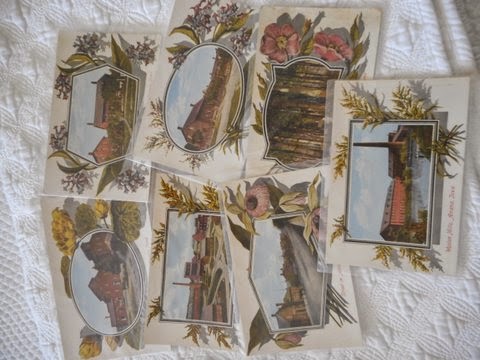
As tourism increased in the Amana Colonies after 1932, there were several ways to advertise and correspond in and out of Amana. Postcards were printed and common across the USA from about 1900-1960's and used to send cheap greetings for any reason- the text message and social media of that era that started in England in the late 1800's. In the early 1900's salesmen who were photographers themselves, traveled the nation's Byways and sold cards in bulk to stores of their town images. The cards helped propel tourism. They came in many styles (linen paper, real photo, silk, artistic signed, chrome), some colored , some in black and white, others sepia brown. There were plain borders, floral borders and more. Some were printed in Germany while others were printed here in the United States. Special, real photos were made into postcards by mail as well. They showed scenes of all famous Amana landmarks, landscapes, people, architecture, disasters, and animals. Simple scenes were postcard worthy in Amana. They showed how Amana was changing and developing. Below is the Amana print works and men hauling ice with the ice wagon and cutter. Hard to find, I find these to be beautiful pieces of art, records of history, and very collectible. Podunk photo.
Subscribe to:
Posts (Atom)

.jpg)