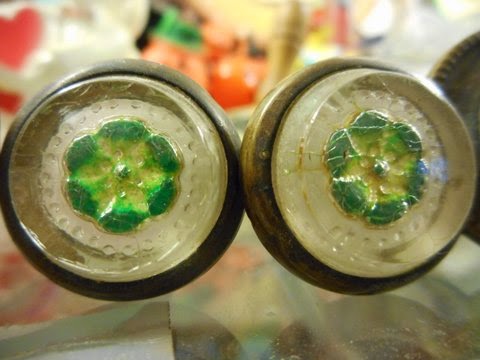
Decoration in the home was not supported much in early Amana so any small touch that could be added, was, and very much appreciated. These small pieces of decor were Victorian Sandwich glass knobs and picture hangers. They were one piece artworks done around 1890. The hangers had glass heads that was left to be displayed above the picture while a long wire held the picture below the nail. They were curtain throwbacks as well.The glass designs were copies of English and Irish cut and pressed glass made in Sandwich, Mass. between 1825 and 1888. It was a simple way to show some color and creativity in the home.
Sunday, November 30, 2014
Saturday, November 29, 2014
Yarn, cord Winders and Swifts...
There were many wooden tools made by local woodworkers some of which were
the yarn or cord shuttle, garden sticks, and the yarn swifts. . Each helped to keep yarns and cords from getting tangled, ready to make into balls and ready to use. The cord shuttles were usually made of bleached pine, while the yarn winders were made of walnut or other hard woods. A must for a knitter, weaver, crocheter, gardener and preparing the deadline or garden rows.
Tuesday, November 18, 2014
Mesquakie Bead Trading
The land that interested the Inspirationists upon their arrival in the Iowa River Valley was once fertile land that the Mesquakie Nation once had claim to but that claim expired in 1843 so there was no problem with conflict. The Mesquakie people would visit or come to set up camp to harvest edible tubers of the American lotus on the area Lily Lake. They knew the land of 26,00 acres well as they used to hunt there in the 1840's later trading game and pelts for medical care and fine Amana woolens. West was the first Amana Village they would visit from Tama. Trades for fresh bread, flour, and grains were made with beads. Sometimes they traded items they made as bead trimmed pin cushions or coin purses of woven beads both transparent ( trade use) and opaque beads (tribal use). Historically the Plains Indians favored beads which were ready made trade goods that they used to decorate everyday and ceremonial objects, using thousands of pony and seed beads and quills for their complex tasks. (1830's). Later in the 1850's only beads and ribbon decorated objects. Until 1900 most bead designs were abstract and geometric- elegant, precise, and beautifully unified and colored, influenced by European designs and beads. The Mesquakie enjoyed a good relationship with German, Amana ancestors. My friend's aunt traded flour for a beautiful, zippered coin purse with a bead-colored, geometric design of diamond shapes on a white background of opaque beads! That flour must have been very important to the Meaquakie that day.
Monday, November 17, 2014
The Sundial..
The Sundial is a device used to tell the time of day by the position of the Sun. In this design which is a horizontal sundial, the Sun casts a shadow from its stylus onto a surface marked with lines, and some not marked, indicating the hours of the day by a thin rod known as a gnomon. On this sundial, as the Sun moves across the sky, the shadow-edge aligns with imagined numbers of the hour. All sundial must be aligned with their styles parallel to the axis of the earth' s rotation to tell the correct time throughout the year. The hour angle must be geographically and horizontally correct as well. There is a sundial located on the old church in High Amana, now the Amana Art Guild, and on the Lace Haus, the former Gene Leichsenring home, in Amana.
Sunday, November 16, 2014
SCHULWALD
In the 1850's pine seedlings were brought from Canadian forests near Ebenerzer, NY, because Iowa had no native pines. Wood was very important to the community, especially for buildings and crafts. Groves of white, spruce, and larch pines were planted and maintained by the school children in South Amana, East Amana, and Amana. These seedlings were from one of the Ebenezer, New York villages. These " school forests" or Schulwalden were special places where children played, families had picnics, and couples took long walks there. The last Amana Schulwald pine trees were downed during World War II, but South and East Amana's still stand. Homestead has its own pine grove now, planted in the 1940's. In the 1970's a small grove was planted by a local teacher and her students on the banks of Price Creek, where one was originally planted in 1860's. These are all very stately groves.
Friday, November 14, 2014
The Amana Style Bench...
Often outside Amana homes and businesses you will see a very comfortable bench on which to rest your weary feet and admire the surroundings. Built by local wood workers it seems it was a design of Mr A.T. Berger in Upper South Amana. Most were left to weather naturally, some were painted. The curved back and foot rest made it quite unique and comfortable. Berger was very talented and now many other wood workers make them.
Amana washboards and tubs

Subscribe to:
Posts (Atom)